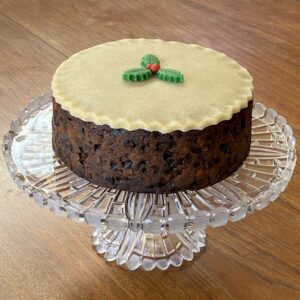
This retro cake recipe draws inspiration from the Australian Women’s Weekly ‘100 Favourite CAKES’ cookbook published in 1972.
Their Christmas Cake (Rich Fruit Cake) is included in their ‘fruit cakes’ section, which can be baked ‘for Christmas, for wedding or birthday cakes, and … for good eating any day throughout the year.’
My Christmas cake is rich, dense fruit cake made with an abundance of dried fruit steeped in brandy.
It is tradition to make Christmas cake on “Stir up Sunday” – the last Sunday before Advent, and about a month before Christmas. This allows time for the cake to be thoroughly “fed” with brandy and to mature, before being covered in marzipan.
This is only one of a range of retro recipes on my website – many based on Women’s Weekly retro cake recipes. Check out the full range of recipes here!
Ingredients
Pre-soak
250g (1 1/3 cup) figs, stalks removed and chopped
100g (1 cup) glace cherries, chopped
50g candied peel, chopped
340g (2 cups) currants
260g (1 1/2 cups) sultanas
1 large orange, finely grated zest
1 large lemon, finely grated zest
130ml brandy, rum or Armagnac
Cake
250g (1 cup) unsalted butter, room temperature
250g (1 1/4 cup firmly packed) light or dark brown sugar (ideally, 50/50 mix)
150g (3 large) eggs, room temperature
65g (2/3 cup) ground almonds
1/2 tsp baking powder
250g (1 2/3 cup) plain flour, sifted
1 tsp flaky salt
1/4 tsp nutmeg, freshly grated
1/2 tsp ground mixed spice
100g hazelnuts, roasted and skinned
Extra brandy, rum or Armagnac to feed the cake
Marzipan
90g icing sugar, extra for kneading and rolling
90g golden caster sugar
50g (1 large) egg
A few drops pure almond extract
1 tsp brandy
175g ground almonds
Method
- To make the pre-soak, combine pre-soak ingredients in a large bowl. Cover to prevent evaporation and leave to soak for a minimum of 12 hours at room temperature, up to three days.
- To make the cake, lightly grease and line the base and sides of a 20cm-diameter (6cm high) round cake tin, ensuring the baking paper lining the sides extends at least 10cm higher than the rim. Tie a double layer of baking paper around the outside of the tin or use pre-soaked baking strips. Set aside until needed.
- Next, adjust the oven rack to the lowest position and preheat the oven to 140C (no fan). Now, in a large bowl, combine the flour, ground almonds, baking powder, salt and spices and whisk to thoroughly combine. Set aside. Then, in the bowl of a stand mixer with the paddle attachment, cream the butter and sugar until smooth, scraping down halfway through. Add eggs, one at a time, beating thoroughly between additions. Add 1-2 tbsp flour mix after the second egg to prevent the mix from curdling.
- Once the eggs are combined, add flour mix to the butter mixture and combine on lowest speed just until there are no streaks of flour left. Finish mixing manually with a spatula, ensuring to reach any pockets of flour in the bottom of the bowl. Add the pre-soak and toasted hazelnuts and fold in well, ensuring all ingredients are thoroughly combined.
- Finally, scrape the mixture into the prepared tin, smooth the top with the back of a spatula. Drop the tin three times to remove any air bubbles in the batter. Gently position a square of baking paper (doubled over with a one inch sized hole in the centre) on top of the rim of baking paper lining the sides of the tin. Bake cake for 4 hours until it feels springy in the centre when lightly touched. Begin checking from 3.5 hours (no sooner). It could take longer than 4 hours, as every oven is different.
- To check whether the cake is done, insert a skewer into the centre. It should come out with just a few crumbs attached to it, no trace of raw cake mixture. Once baked, take the cake out of the oven and immediately brush on 1-2 tablespoons brandy, rum or Armagnac. Turn in the edges of the baking paper and cover the cake firmly with a layer of aluminium foil lined with baking paper while the cake is still hot.
- Leave the cake to cool completely (about 12 hours). Once cool, remove the cake from its tin leaving the baking paper in place. Wrap cling wrap tightly around the baking paper and store in an airtight container. Do not wrap in foil as it can react with the alcohol.
- To feed the cake, once per week, ‘feed’ the cake by making small holes in the top and bottom with a toothpick and spooning 1-2 tablespoons of brandy, rum or Armagnac over the surface. Ensure the alcohol moistens but does not drench the cake, so that it does not become soggy – 1-2 tablespoons at a time, once per week is more than enough. In the final week before Christmas, do not feed the cake to allow the surface to dry.
- To make the marzipan, sift the icing sugar and caster sugar into a bowl that will sit over a saucepan of water. Stir in the egg. Place the bowl over a pan of barely simmering water and whisk for about 10 minutes, until the mixture is thick and fluffy.
- Remove the bowl from the heat and sit the base in about 5cm of cold water. Whisk in the almond extract and brandy and continue to whisk until the mixture is cool. Stir in the ground almonds and knead on a surface lightly dusted with icing sugar to form a firm paste. Wrap in plastic wrap and store in the fridge or freezer until needed. Bring to room temperature and knead well before using.
- To cover the cake, roll out the marzipan on a sheet of baking paper or a surface lightly dusted with icing sugar. Make intermittent quarter turns to keep the shape round and to prevent sticking. Using the base of a 20cm cake tin or a cake ring as a template, cut a disc of marzipan to fit the top of the cake. Gently lower the marzipan into place, and smooth with a fondant smoother or a rolling pin. There should be enough moisture from the cake to help the marzipan adhere.
- Leave the marzipan to dry overnight in a cool place before lowering carefully into a biscuit tin and covering with a lid. It is important the cake is stored somewhere cool and dry, otherwise the covering will turn sticky. The marzipan can be further iced with royal icing, or left as is. If covering with royal icing, allow the marzipan surface to dry for at least a week.
This cake will keep for months if wrapped tightly and stored in an airtight container in a cool, dry place. The marzipan will also keep for several months (due to its high sugar content and heat treatment).


Around sometime in the 70 or 80’s, The Women’s Weekly published a Christmas Cake + Pudding recipe all made in the same mixture, then divided in 2 and the cake was baked while the pudding was steamed. I made them each year for Christmas for many years but not for a long time. I always kept the recipe, but sadly after many moves I can’t remember which box it ended up in and I’d like to make them again. I think the recipe was very much like this 1972 variation. Would you happen to know the one I’m talking about?
Hello Josephine, the recipe you may be are referring to is the Women’s Weekly “three-in-one” Christmas fruit cake mix. It makes a fruit cake, fruit pudding, and fruit mince pies. I found a vintage recipe from 1978 here: https://trove.nla.gov.au/newspaper/article/57644832/5841473 Does this look similar? The cake and pudding mix differ slightly – some of the flour in the pudding is replaced with breadcrumbs. Happy baking 🙂