This recipe draws inspiration from the Australian Women’s Weekly retro biscuit recipe for florentines in their ‘100 delicious Biscuits and Slices‘ cookbook published in 1972. You’ll find it in the section titled ‘Special Occasion Biscuits’.
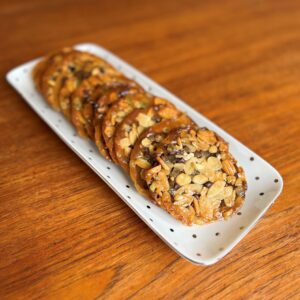
Florentines are a thin, lacey biscuit containing nuts and candied or dried fruit bound together in a rich caramel that is baked until golden. The base is coated with a fine layer of chocolate that is traditionally scored in a wave pattern.
Many people ask: are florentines Italian or French? The name would suggest Italian, but it is likely the classic florentine biscuit was created by the French in the seventeenth century. The use of butter and cream in the biscuit base is a clear indicator of its origin.
The very retro, very kitch Australian Women’s Weekly recipe for florentines uses condensed milk, cornflakes and sultanas. My florentines recipe, while inspired by this retro classic, is a little more traditional. My florentines recipe contains flaked and slivered almonds, candied citrus and cherries, bound together in a caramel rich with honey, butter, cream and spice. Yum.
This is only one of a range of classic biscuit and cake recipes on my website – many based on women’s weekly classic baking recipes. Check out the full range of recipes here!
Ingredients
40g butter
25g glucose syrup
25g honey
50ml cream (35% fat)
80g golden caster sugar
Generous pinch flaky salt
1/4 tsp ground cardamom
75g flaked almonds
25g slivered almonds
50g cedro, chopped
50g glace cherries, chopped
200g dark chocolate (minimum 70% cocoa solids)
Method
- Heat the oven to 190˚C (170˚C fan forced). Line two baking trays with baking paper. (I used two 31cm x 31cm trays.)
- Place the sugar, cream, honey, glucose syrup, butter, salt and cardamom into a saucepan over medium heat. Stir until the ingredients are combined and reach a light golden colour. Remove from the heat and add in the almonds, cedro and cherries. Mix until well incorporated.
- Transfer four teaspoon sized mounds of mixture onto the first baking tray, ensuring they are well spaced to allow for the biscuits to spread while baking. Bake in the pre-heated oven for 7-10 minutes, until golden brown. Halfway through baking, gently press down any Florentine centres to ensure they are flat and even. Once a deep and uniform golden brown, remove from the oven.
- This next step is optional, but if you would like your Florentines to be a perfect circular shape, as soon as they are removed from the oven and still hot, use a round cutter (around 110mm in diameter) to gently guide the Florentines into even round discs. Allow to cool on the tray at room temperature. Alternate baking cookies with the two baking trays, baking the next batch while the first is cooling.
- To temper the dark chocolate, place it into a microwave safe plastic container. Heat at 30 second increments, stirring well in between. Once the chocolate is 50% solid and 50% liquid, remove from the microwave and stir vigorously until the chocolate is completely melted and uniform. If there are any small lumps remaining, they can be melted with a hairdryer. (Avoid returning the chocolate to the microwave, because there is a risk of overheating and losing temper.)
- Working quickly, spread a thin layer of the tempered chocolate over the base of each Florentine. Run a fork or tiling comb over the chocolate to create a wave pattern. Allow to set at room temperature before storing in an airtight container.